Lunéville tambour embroidery
Two hands work on opposite sides of a taut textile, turning linked stitches into lines, texture and light.
EUROPE TODAY / Clothing
Steam, a shaped block and careful stitching turn flexible material into a wearable volume.
A hat begins as a relationship between material and volume. Its crown must sit on a head; its brim establishes a line around the face. Before making starts, the milliner considers measurements, the intended occasion, the chosen material and the silhouette. A drawing becomes a practical plan for a three-dimensional object.
The route changes with the material. Felt can be steamed and stretched over a block. Straw braid is sewn into a developing shape. Cloth can be cut from a pattern and assembled. Handmade millinery can therefore combine hand control with specialist sewing equipment: the presence of a machine does not remove the maker's responsibility for the emerging form.
An Onisep workshop film shows this living skill through a practising French milliner. Her account moves between robust operations, such as stretching felt and fixing it to a wooden block, and precise needlework. She also describes allowing a stiffened hat to dry before its final finishing. The waiting period belongs to the process, even when no hand is touching the work.
Current French vocational training still teaches this combination of design, materials, pattern work, cutting, assembly, moulding and finishing. For the visitor, the most revealing comparison is between the hat on its block and the finished piece. Examine how the crown meets the brim, how an edge is resolved and how a ribbon or other trimming is attached. Those transitions make the construction legible.
An introduction to the sequence. Materials, tools and working methods vary with the project.
Take the relevant measurements and develop the design. Choose a material and making route suited to the intended crown, brim, occasion and relationship with the wearer.
For blocked felt, use steam and controlled stretching over a suitable form. For other designs, sew straw braid or assemble pieces cut from a pattern.
Apply the appropriate stiffening or preparation and allow the shape to settle. The documented workshop leaves its treated hats to dry before returning to the finishing.
Complete the internal finish, edge treatment and chosen trimmings. Inspect the overall volume and the small stitches together before considering the piece complete.
THE DECISIONS BEHIND THE DETAIL
FILM · Chapelière-modiste
A practising French milliner explains shaping, sewing and finishing. Onisep TV film, April 2023.
KEEP EXPLORING
Two hands work on opposite sides of a taut textile, turning linked stitches into lines, texture and light.
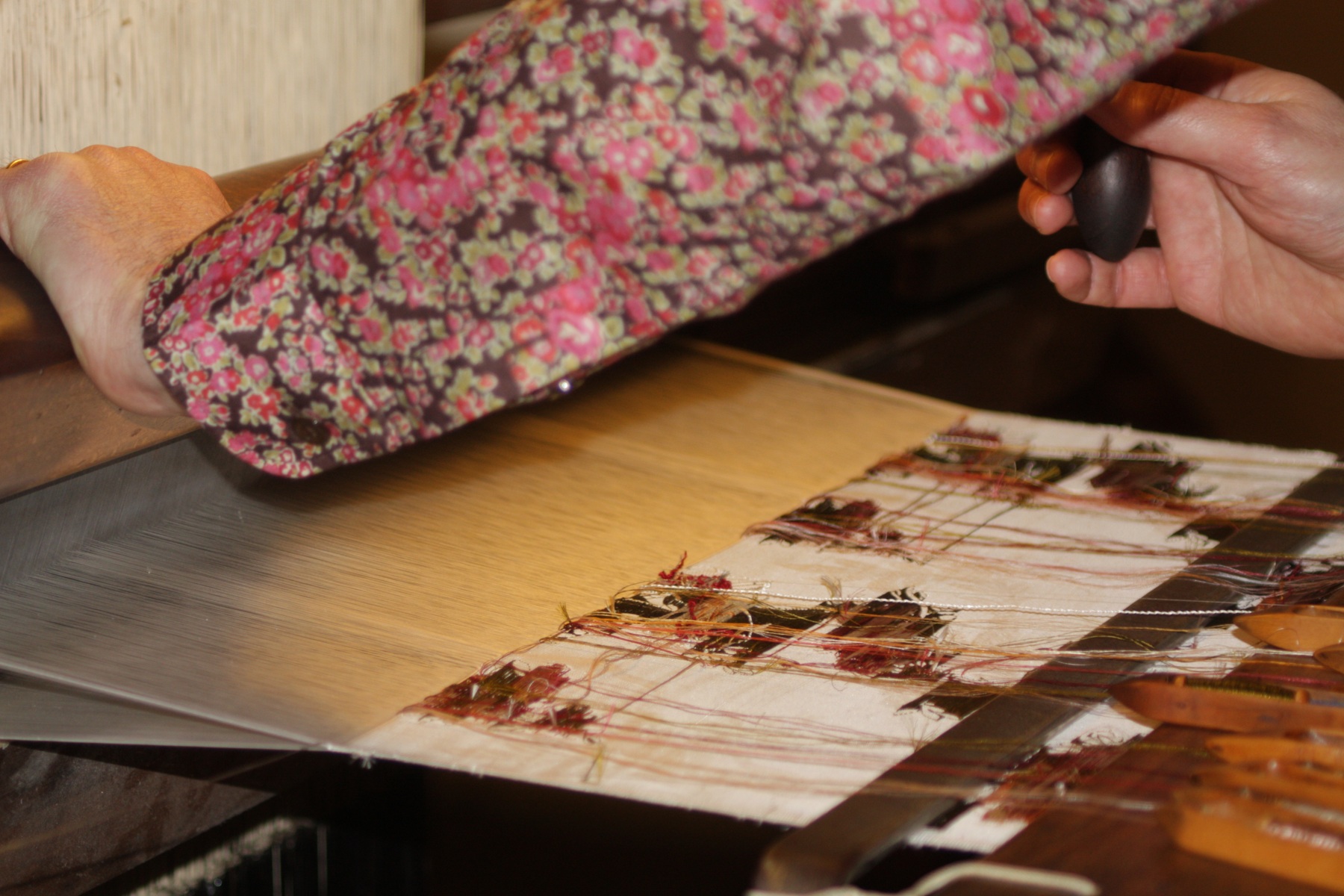
Yarn, pattern and loom settings meet in the surface of the cloth.
Fine thread becomes a textile through the accumulation of needle-made structure.